简体中文
简体中文 ENGLISH



 All Products
 Home
Home Products
 About
About News
News Download
 Contact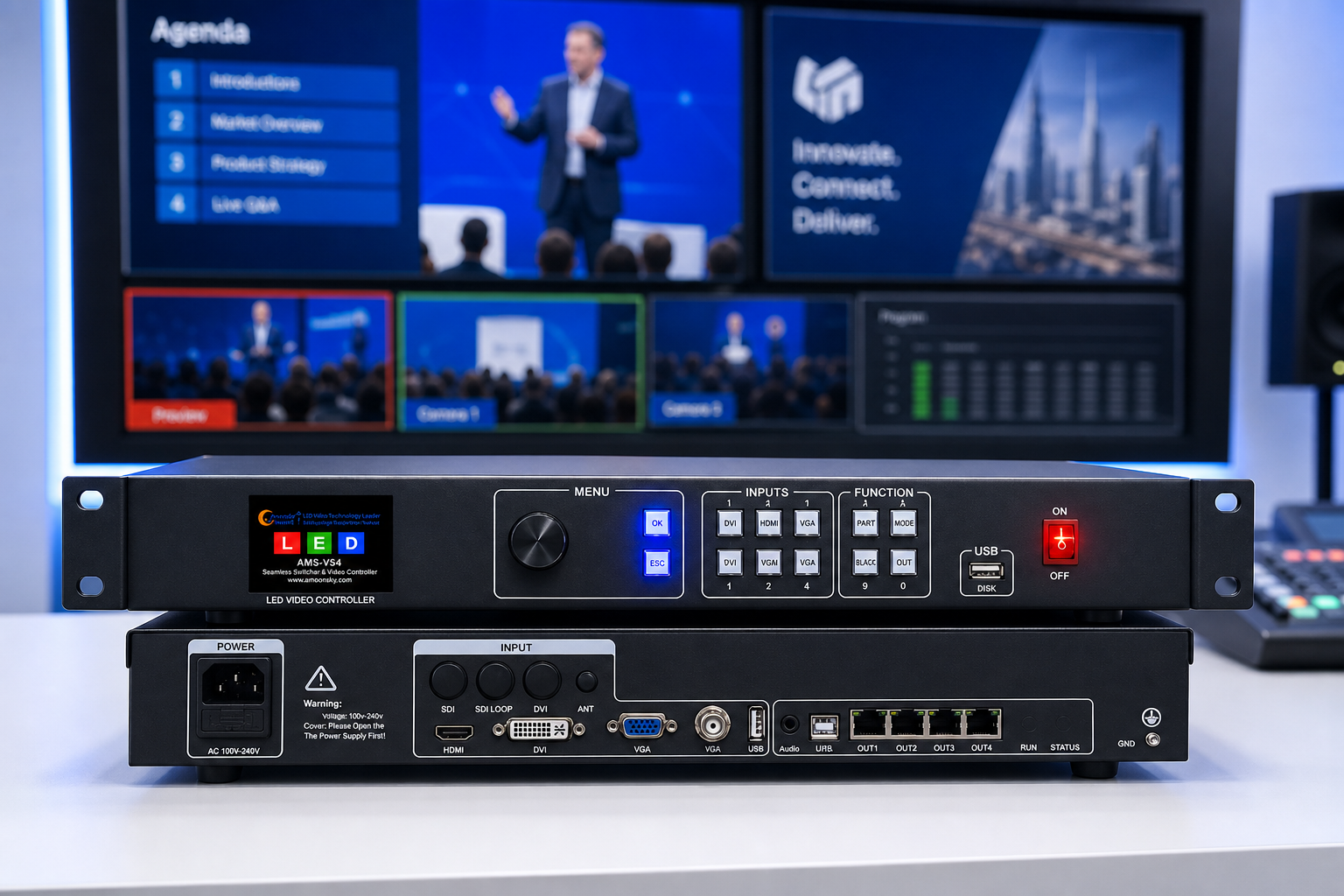
Start With the Screen System, Not the Box
Many buyers begin by searching for an LED video processor, LED controller, or LED video controller. Those terms are useful, but they do not describe the whole project. A single indoor LED wall, a stage backdrop, a showroom presentation wall, and a multi-window monitoring display can all need different processing logic.
The first question is simple: what should the screen do during real operation? If the LED display mainly shows one full-screen source, the selection can focus on stable input, output resolution, sending capacity, and convenient switching. If the system needs several live feeds, presentation windows, camera previews, or monitoring views at the same time, a multi-window video processor or higher-level video wall processor direction becomes more important.
Practical rule: choose by signal path first, then by model. Input types, output method, screen size, window count, and control workflow should come before cosmetic feature lists.
When the LED Controller Should Drive the Screen Directly
For compact LED walls and event screens, an integrated LED screen controller can reduce system complexity. The Amoonsky AMS-VS4 is a good example of this direction. It combines video processing with a built-in sending card, supports multiple input types including AV, VGA, DVI, HDMI and USB, and provides four RJ45 Gigabit Ethernet outputs for LED display control.
This type of device is useful when the project needs a clear, direct path from source to LED wall. Functions such as seamless switching, USB playback, audio synchronization output, and preset save/recall can make daily operation easier for rental events, product presentations, meeting rooms, and small-to-medium LED wall installations.
When Video Processing Comes Before the Sending System
Some systems separate front-end video processing from the downstream sending or display control layer. In that case, the processor is selected for input management, format conversion, scaling, switching behavior, and output routing.
The Amoonsky AMS-MVP300 fits this front-end processor role. It is positioned as a 5-channel LED video processor with AV, VGA, DVI, HDMI and USB inputs, dual DVI outputs, seamless switching, USB playback, audio synchronization output, and preset save/recall. It is better discussed as a processing and routing device than as a direct RJ45 LED sending solution.
That distinction matters for SEO and for real project communication. A customer searching for an LED video processor may need either a direct LED controller or a front-end processor. The article, product page, and sales response should make the system role clear instead of treating every controller keyword as the same requirement.
When Multi-Window Control Becomes the Main Requirement
For larger display systems, the key requirement may not be a single clean full-screen image. It may be multi-window operation: one large background, several camera feeds, a presentation source, a monitoring interface, or a live control view shown together.
The Amoonsky EX400 points toward this kind of project. It is a 4K multi-window LED video controller with HDMI, DP and optional SDI / USB / WiFi input variants, four RJ45 Gigabit Ethernet outputs, two layers, up to four windows, seamless switching, custom EDID, custom output resolution, output monitoring and PC control. Those capabilities make it relevant when LED wall control depends on both source flexibility and screen layout.
A Practical Selection Map
Focus on input compatibility, output resolution, sending capacity, seamless switching, and simple on-site operation.
Check how fast operators can switch sources, recall presets, play backup content from USB, and keep audio in sync.
Review window count, layer structure, EDID control, monitoring, PC control, and how the processor works with the LED wall layout.
| Project need | Useful product direction | Amoonsky example |
|---|---|---|
| Direct LED display control with a compact signal path | Integrated LED video controller with sending output | AMS-VS4 direction, with built-in sending card and four RJ45 outputs |
| Front-end input processing and DVI output routing | LED video processor before the display control layer | AMS-MVP300 direction, with multi-input processing and dual DVI output |
| Multiple windows, monitoring, and flexible screen layout | 4K multi-window LED video controller | EX400 direction, with up to four windows and PC control |
What Not to Assume Across Models
One processor family can cover several application directions, but not every function belongs to every model. Optional inputs, sending methods, output ports, window count, and control software should be checked model by model. For example, WiFi or SDI should not be written as standard unless the selected configuration confirms it.
This is why an effective selection conversation should include source list, expected resolution, LED wall size, receiving system, number of windows, operator workflow, and whether the processor must send directly to the LED display or feed another control layer.
Confirm whether they mean direct LED sending, front-end processing, or a controller for a specific LED screen ecosystem.
Ask about window layout, source count, monitoring, and whether the display is LED, LCD splicing, or a mixed system.
Talk to Amoonsky With the System Details
To choose the right LED video processor for a multi-screen display system, share the input sources, target screen resolution, LED wall size, number of display windows, expected control method, and whether direct RJ45 LED output is required. Amoonsky can then match the project to the right LED controller, LED video controller, or multi-window processing direction.